Glazing a Hotel or Restaurant Terrace: Trade All Year and Earn the Investment Back
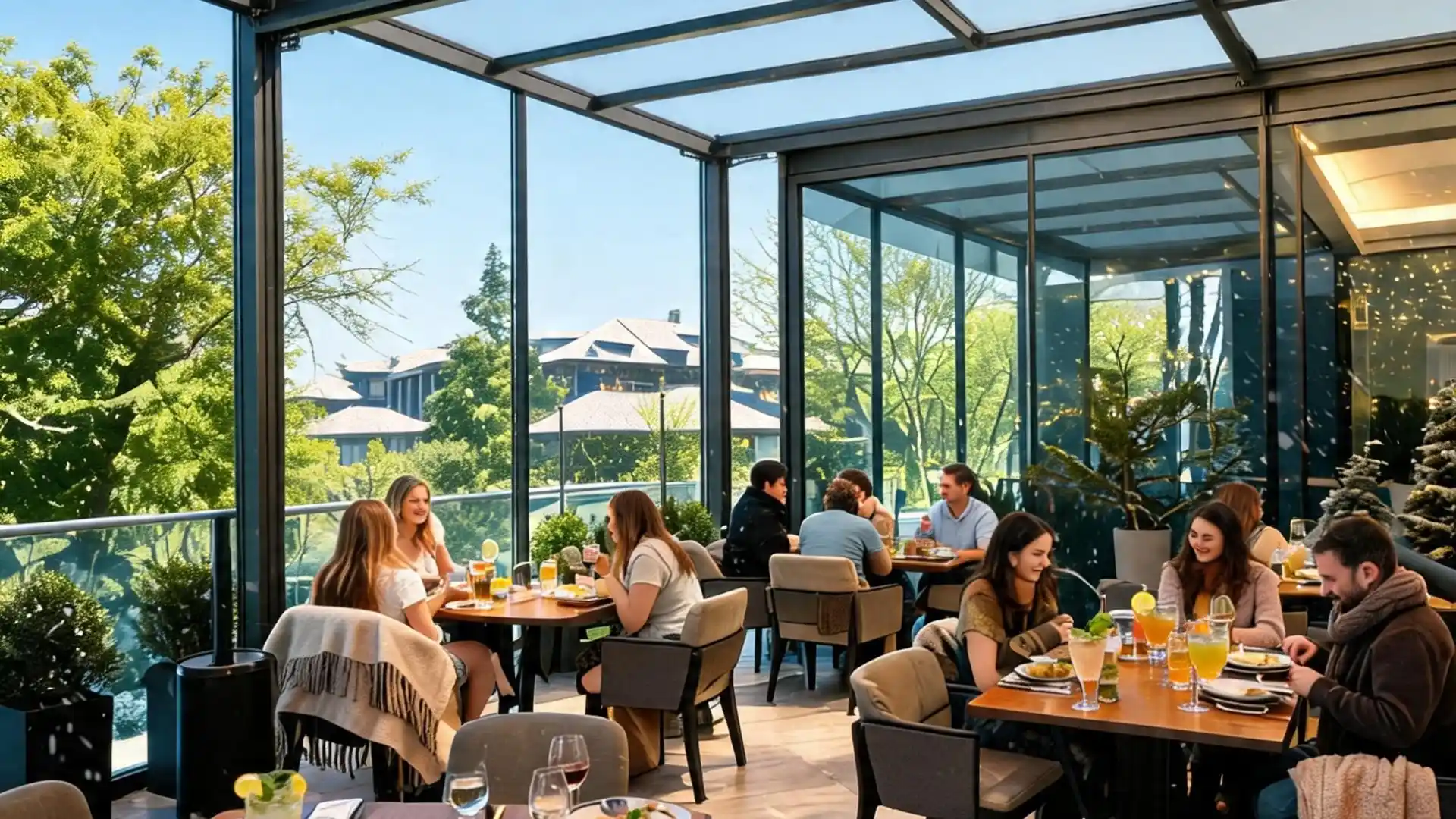
In summer the terrace carries half your revenue; by November it sits empty. Here is which sliding systems turn it into a real year-round room — and how fast that pays for itself.
On the Adjara coast the open-air season is short. From November to March, sea wind and rain take your terrace out of service, while rent, taxes and part of the payroll stay exactly the same. Glazing a terrace is not decoration — it is a way to bring back into use floor space you already pay for.
Count the space that stands idle
Do the simple math: covers on the terrace, average check, months the area is closed. For a restaurant with 40 outdoor seats, a closed winter means hundreds of lost checks a month. Hotels lose differently — a panoramic lounge or a rooftop with a sea view sells bookings, while a terrace wrapped in tarpaulin sells nothing.
A glazed terrace solves three things at once:
- the room works in rain, wind and shoulder season;
- the sea and city view stays, and with it the premium feel of the seating;
- in summer the system opens fully and the terrace is open-air again.
Which systems suit hospitality
Frameless glazing
Tempered glass panels slide and stack neatly against the wall. No posts, no visible frames — the panorama stays uninterrupted. This is the right choice where the view is the product: sea-facing terraces, rooftops, summer halls. Frameless systems block wind, rain and dust and noticeably raise the indoor temperature, but their thermal performance is softer than a framed system, so for a heated year-round room they are usually paired with heating or combined with a warm contour.
Framed panoramic sliding systems
Here the glass sits in a profile and you get a full insulated unit. A double-chamber 4-12-4-12-4 unit with a low-emissivity coating keeps heat in winter and cuts overheating in summer — and in Batumi a baking panoramic room is as much a business problem as a cold one. Large sashes travel on tracks and steal no floor space when opening, which on a narrow terrace literally means extra tables.
Warm aluminium profile
For wide spans, heavy sashes and floor-to-ceiling façades we use warm aluminium with a thermal break. It carries large glass fields, handles salty coastal air and looks right in a premium interior. This profile is the basis for a genuine winter garden that works as a proper dining room rather than an insulated canopy.
Decisions to make before you order
Heating and ventilation. Glass keeps heat, it does not create it. Plan infrared heaters or underfloor heating together with the glazing, not after it.
Safety. In public spaces glass must be tempered or laminated. Laminated glass stays on the interlayer if struck instead of falling apart. For level changes, stairs and podiums use tempered glass balustrades that keep the view open.
How the space transforms. Answer one question: what does this terrace look like in July? A fully retractable system and a fixed screen with a few working sashes are different budgets and different service logic.
Hardware. In hospitality a sash is operated dozens of times more often than at home. We fit premium Lamex hardware precisely because mechanism life matters here.
Why producing it locally in Batumi helps
GND Group is a full-cycle plant in Adjara: our own automated TRUETEC line, TRUETEC CNC glass cutting, a vertical washing machine, a JYJJ-03 butyl sealant extruder and two-component sealing. We make the insulated glass units ourselves, in any size the project needs, and work directly with clients — no middlemen, which is where the pricing comes from.
What that means for your property:
- standard production time of 5–7 working days, so the job fits into the low season;
- non-standard sizes for the real geometry of your terrace;
- GOST certificate of conformity, ecological certificate, REHAU partnership;
- 10-year warranty on IGU sealing, 5 years on profile systems and hardware;
- service next door: production at 7a Sulkhan-Saba Orbeliani St., site visits across Adjara.
For hotels and restaurant groups there is one more benefit: consistency. The same quality across phases, repeat batches from the same workshop, one clear contact for warranty questions.
How to estimate payback
Take one summer month of terrace revenue and multiply it by the months the area currently sits closed. Even at a conservative winter load of 40–50% of summer levels, payback is measured in seasons rather than years. Then add the side effects: trading on rainy summer days, lower heat loss in the main hall, and a façade that markets the venue to everyone walking past.
Where to start
Start with a survey and a quote — before design drawings and before the budget is locked. Our engineer visits the site, checks the structure, parapet, drainage and wind load, and proposes an option that matches how you actually operate.
Site surveys within Batumi are free. Send us a short description of the terrace and we will prepare a calculation based on your exact dimensions.