Glass Balcony and Staircase Railings: Will They Actually Break?
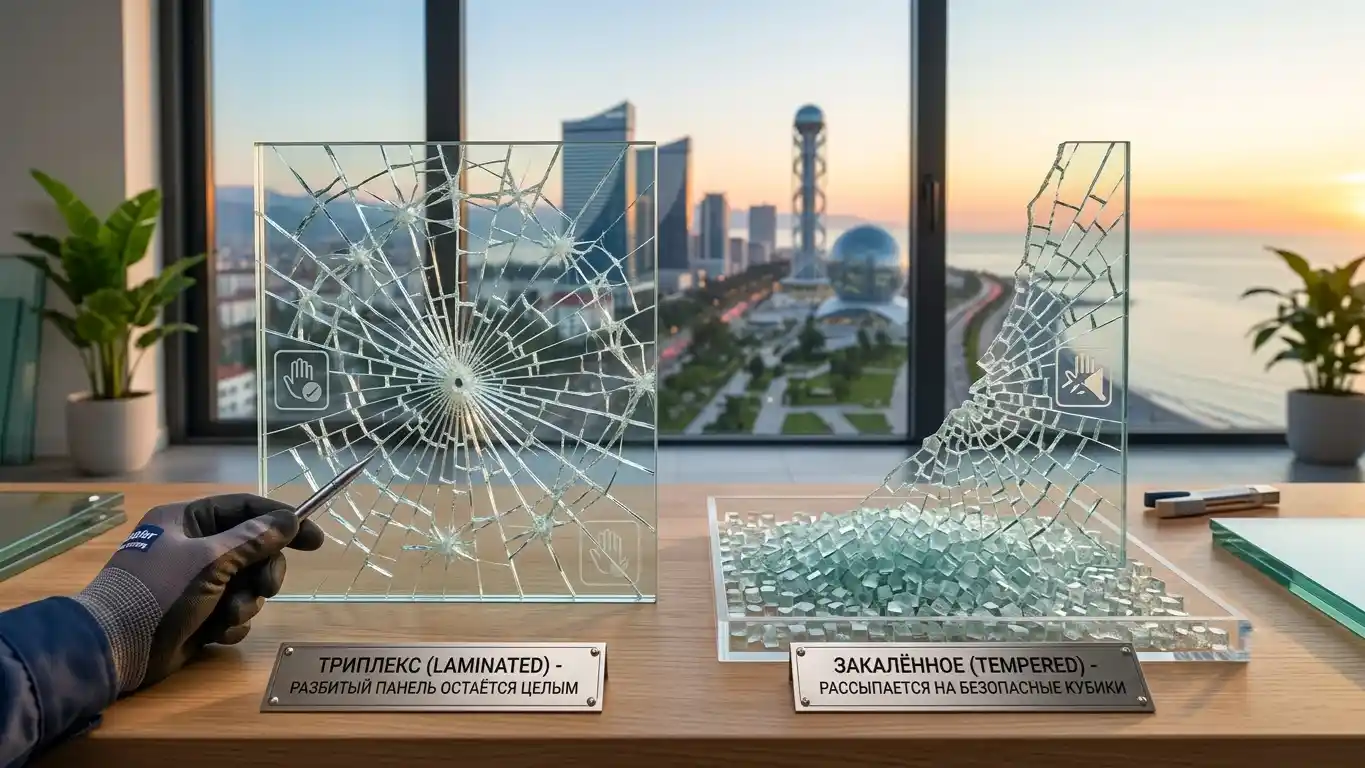
The biggest worry about glass railings is safety in case of breakage — here's the real difference between tempered glass and laminated glass in practice.
Why glass railings make people nervous
Swapping metal balusters for a glass railing on a balcony or staircase almost always brings up the same question: what happens if it breaks? The concern is fair, especially with kids around or when the railing sits several floors up. But the worry usually comes from not knowing that railing glass isn't the same as a window pane — it's a structural material processed specifically for this job.
Two types of glass are used for railings: tempered glass and laminated glass (triplex). They behave very differently when damaged, and that difference is what decides where each one belongs.
Tempered glass: strength and how it fails
Tempered glass goes through a heat treatment process that makes it far more resistant to impact and bending than ordinary glass. It handles everyday knocks, a stray ball, dropped objects. But if it does break — from a hidden flaw or a sharp point impact — it shatters into small, blunt fragments with no sharp edges. That's a deliberate safety feature: the pieces are far less likely to cause deep cuts.
One important detail: tempered glass fails all at once, across the whole pane. For a staircase or balcony railing, that means when it breaks, the barrier is briefly gone until the pane is replaced.
Laminated glass: stays in place after impact
Laminated glass (triplex) is built from two or more glass layers bonded with a tough polymer interlayer. Under an impact strong enough to crack it, the glass fractures but the pieces stay held by the interlayer instead of falling apart. The railing keeps functioning as a barrier even after damage, until it's replaced.
That's why laminated glass is the preferred choice where the stakes are higher: staircases, upper-floor balconies and terraces, and high-traffic spots like hotels, restaurants, and commercial buildings. There, it's not just about withstanding a hit — it's about not leaving an open gap the moment something goes wrong.
What thickness is actually safe
The right glass thickness for a railing depends on the installation height, the span between supports, the mounting method (point-fixed, framed, frameless), and how the space is used. A balcony railing in a private apartment and a staircase railing in a hotel lobby are calculated differently — more foot traffic and higher loads call for a thicker, more robust glass build-up. Matching thickness to your specific structure is an engineer's job at the measurement stage, not something you can pull from a generic chart online.
What safety standards actually cover
Glass railings aren't decorative — they're structural elements that carry load and protect people. That means three things matter: the type of glass (tempered or laminated), the thickness of the build-up, and how it's fixed to the supporting structure. Getting any one of these wrong turns an attractive railing into a genuine hazard, no matter how good the glass itself is.
We produce both tempered glass and laminated glass on our own production line in Batumi and match the solution to the actual project — a balcony in an apartment, a staircase in a private house, or a terrace railing at a hotel. At the measurement stage, our engineer assesses the load, height, and mounting method and proposes a solution that won't need reworking a year later.
If you're planning glass railings for a balcony, staircase, or terrace, request a free on-site measurement — we'll come out, calculate the details, and tell you exactly which glass fits your project.